
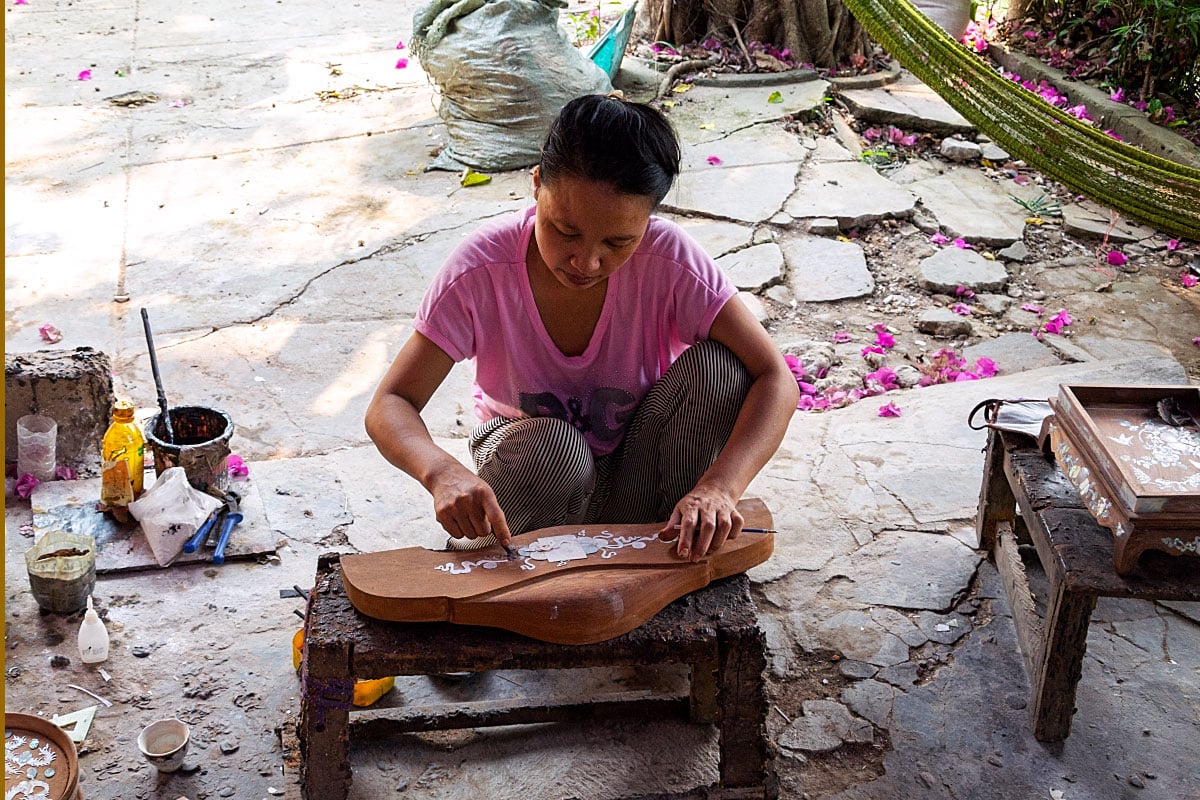
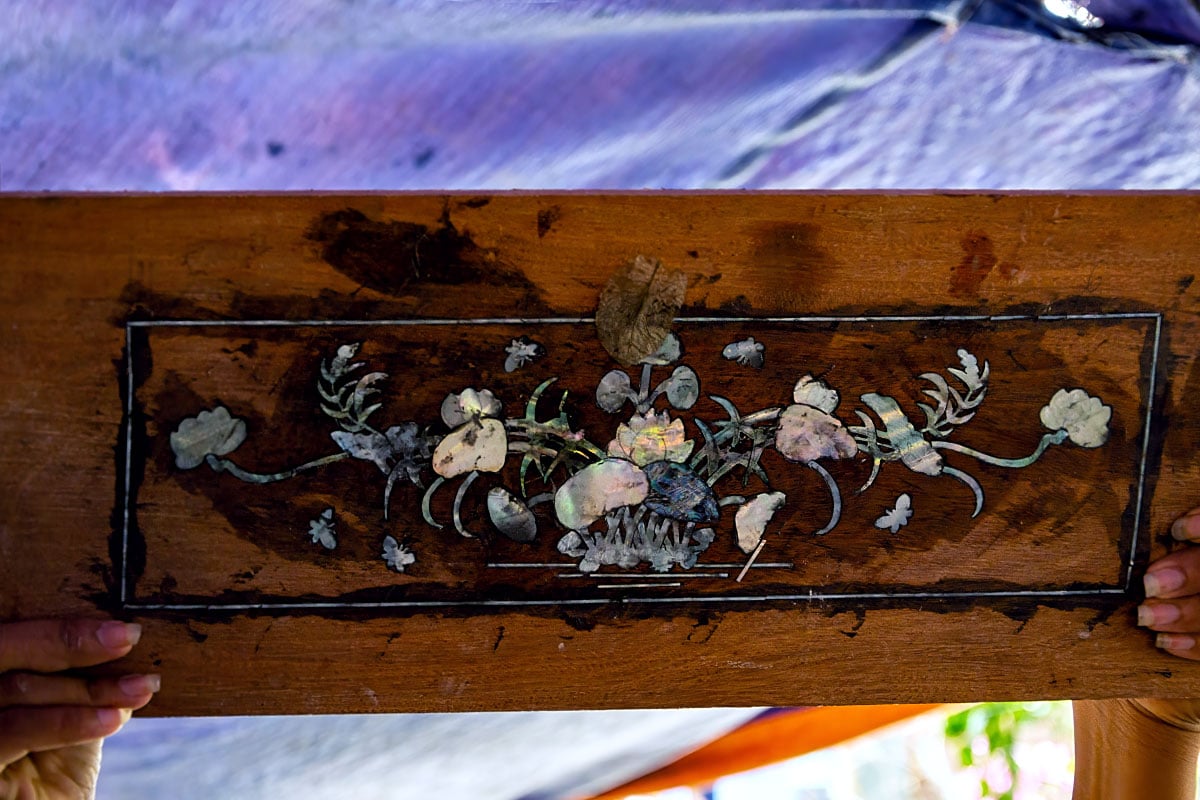
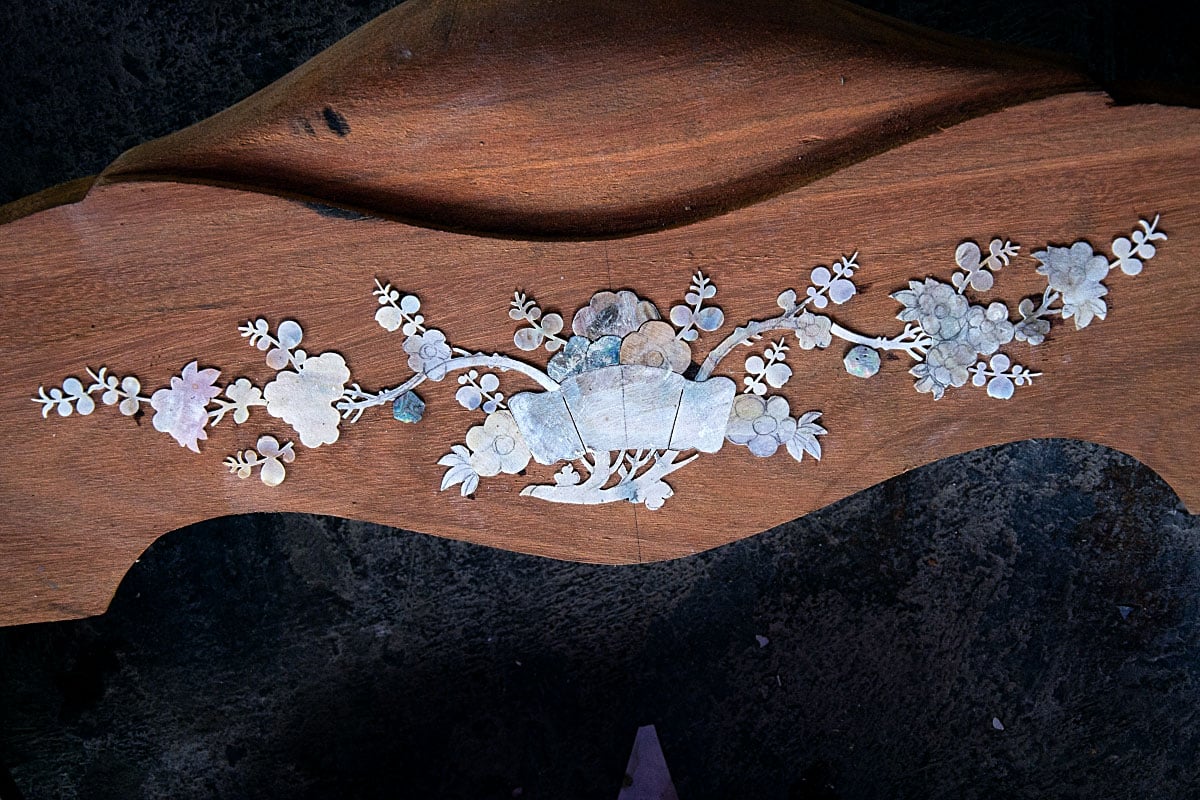
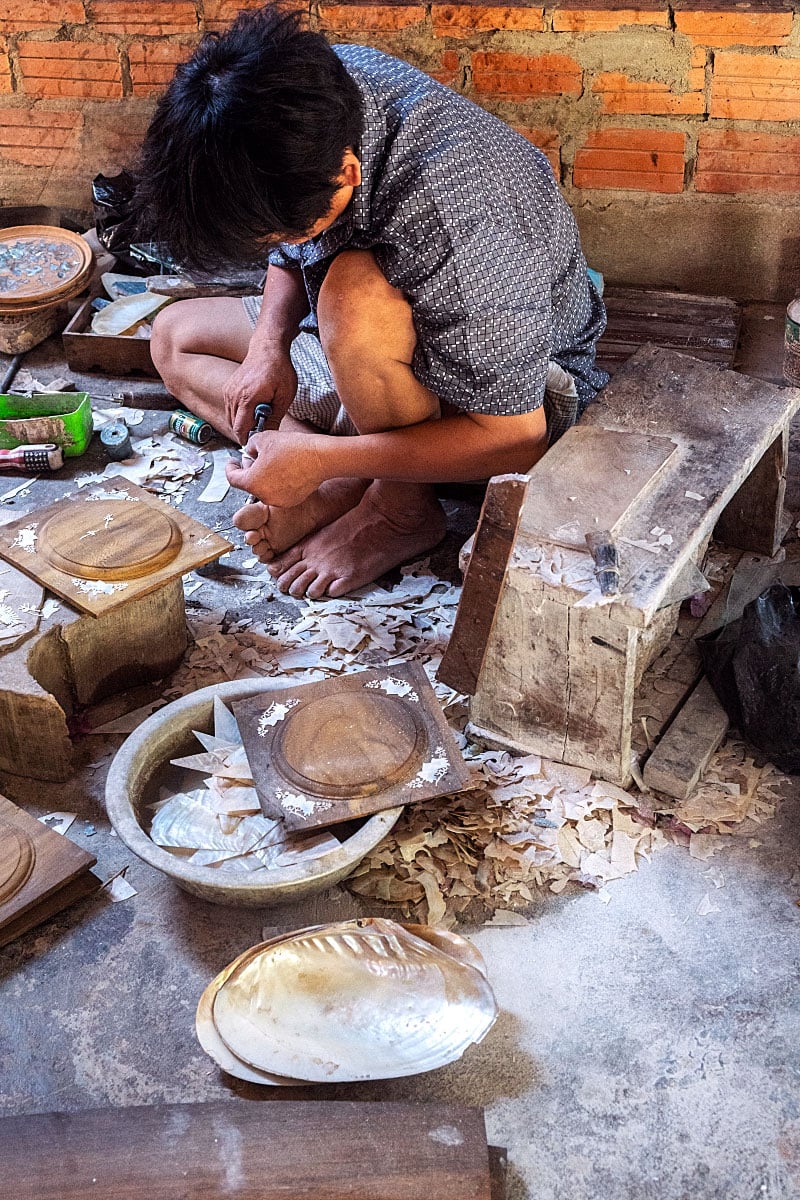


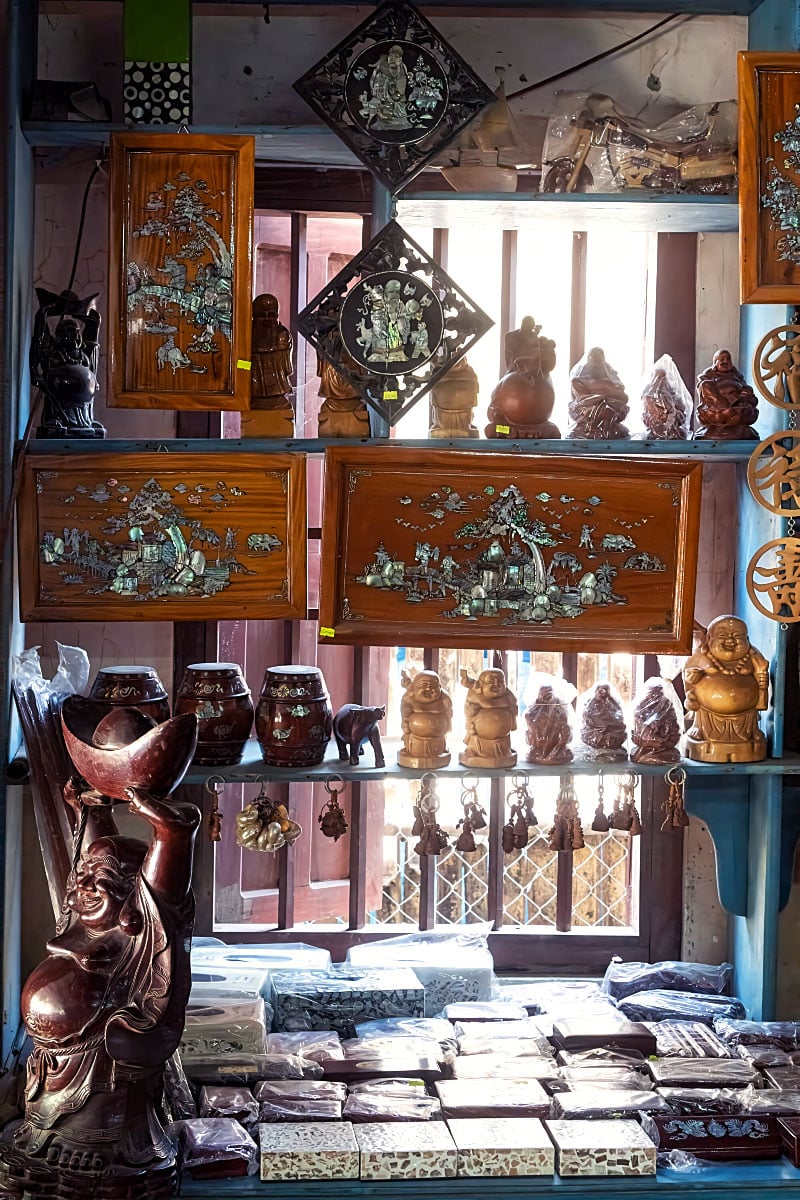
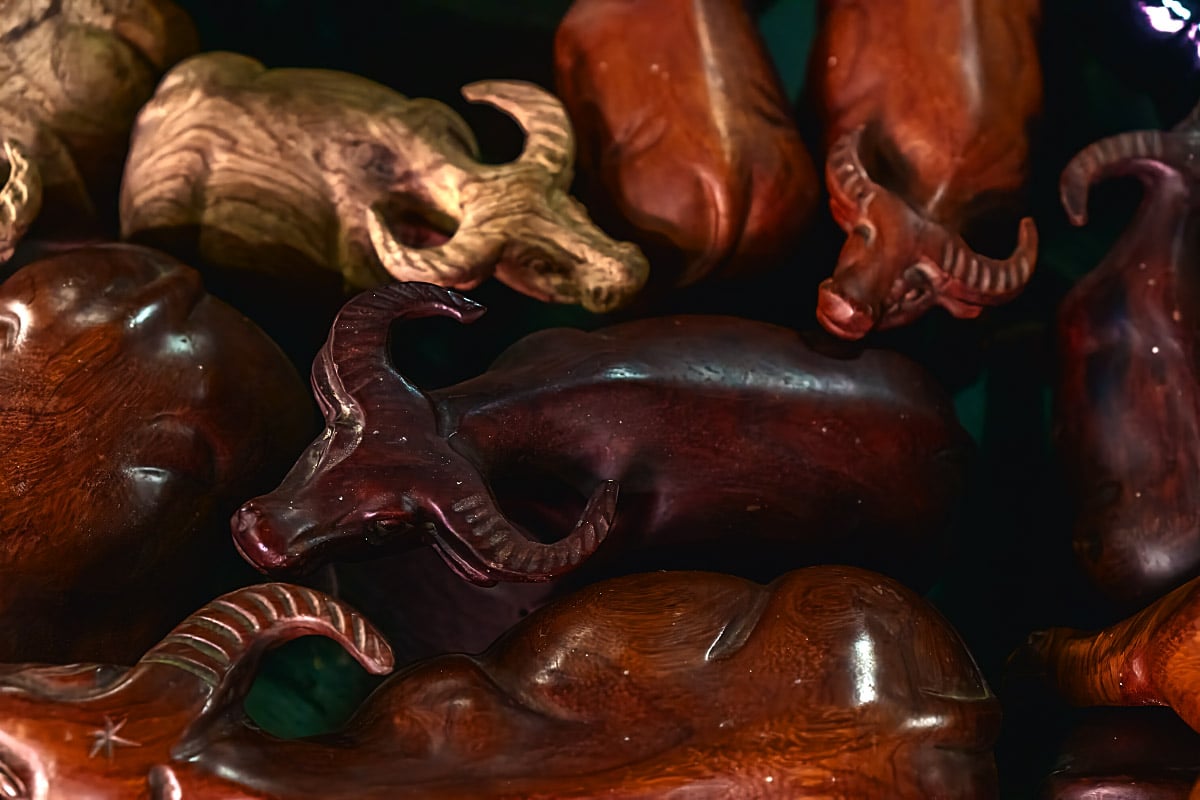
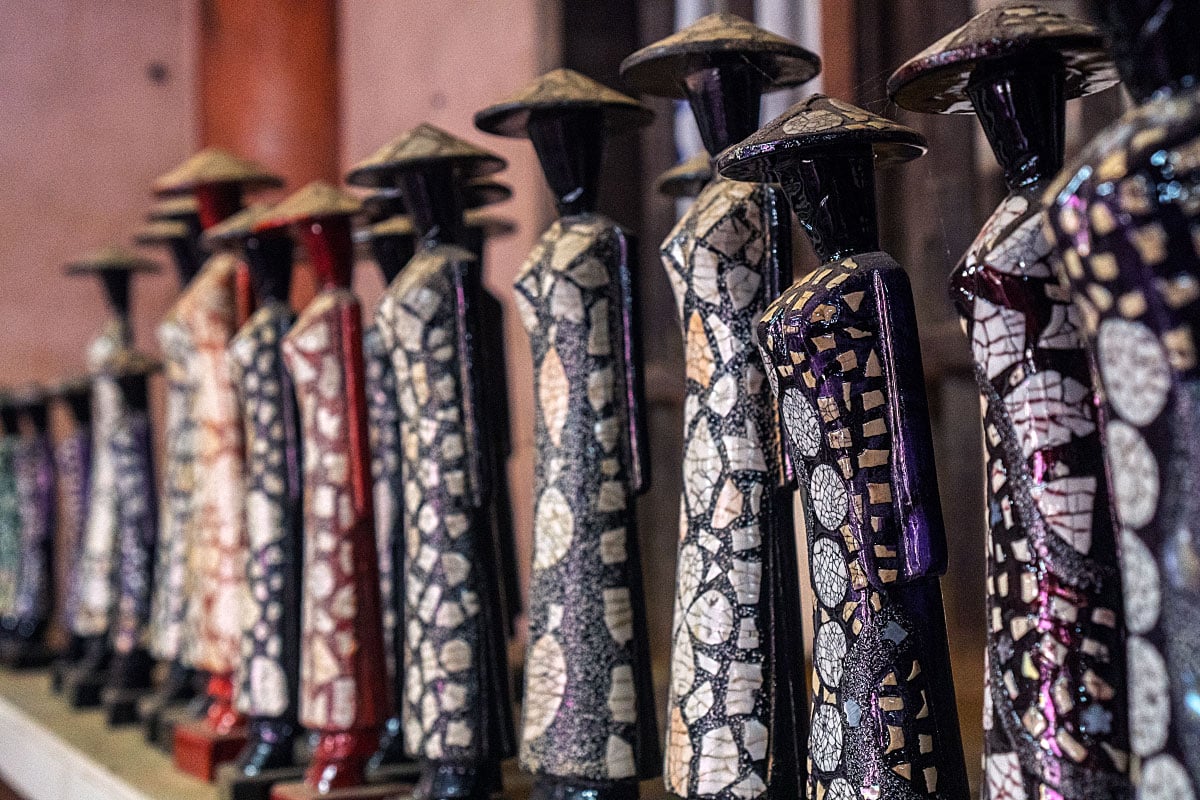
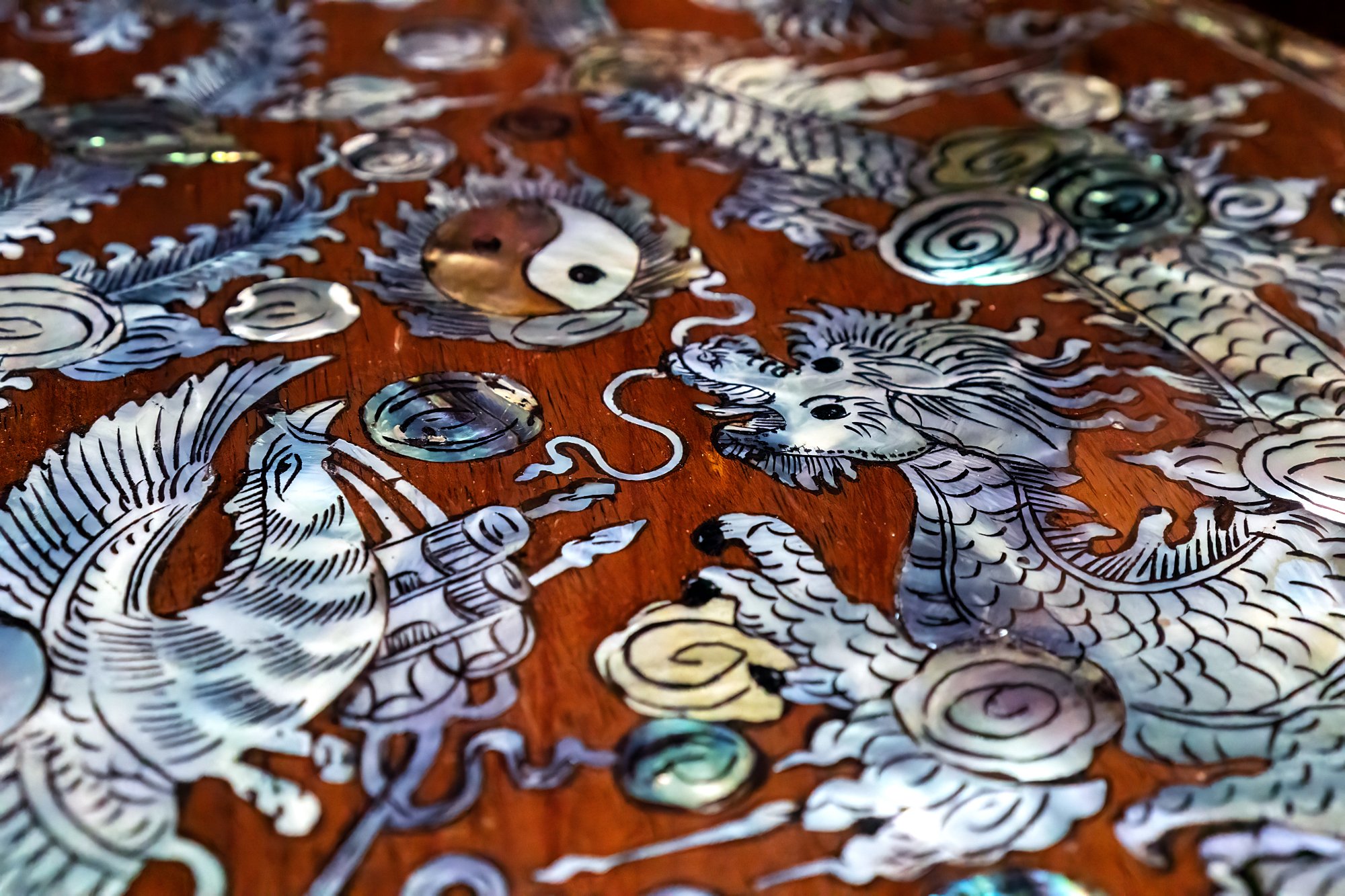
Mother-of-pearl inlay was one of the details that kept drawing my attention to Vietnamese woodworking. Small pieces of shell become part of a wooden surface, catching the light while the grain remains visible around them. Watching the work being made was just as interesting as seeing the finished objects. The careful carving, repeated fitting and concentration at a low worktable gave me a better appreciation of something I might otherwise have admired briefly and walked past.

Contents
What Is Mother-of-Pearl Inlay?
Mother-of-pearl inlay is a decorative technique in which shaped pieces of shell are set into a surface, often wood. Mother-of-pearl itself, also called nacre, is the iridescent inner lining of certain mollusk shells. Its layered structure produces the shifting colors that make a small fragment so interesting to look at. The material is shell, not a collection of small pearls.
In Vietnam, the craft is commonly known as khảm trai; khảm xà cừ and cẩn xà cừ are related names you may encounter. It appears in wooden furniture and lacquerwork, from cabinets and screens to decorative panels and smaller objects. Although I initially thought of it simply as seashell decoration, the materials can include freshwater shells as well. What matters to the design is the usable nacre and how the artisan shapes and places it.


How Vietnamese Mother-of-Pearl Inlay Is Made
The basic process involves planning a design, cutting the shell, making matching recesses, fixing the pieces in place and finishing the surface. Exact methods vary between wood inlay and lacquerwork. Vietnam’s national tourism authority describes these broad stages in its account of Chuon Ngo artisans, while the National Museum of History documents the more detailed lacquer process.
- Plan the pattern. The design establishes where the shell pieces will go and how they fit into the overall composition.
- Cut and shape the shell. Small saws and files turn the selected material into individual elements of the design.
- Mark and carve the recesses. The prepared shapes guide the outlines in the base, which is cut to receive them.
- Fit and secure the pieces. Each element is checked against its recess and attached with a suitable binding material.
- Finish the surface. Leveling and polishing bring the pattern into view; lacquerwork can involve repeated coating, drying and sanding stages.
The repeated fitting was what held my attention. A small adjustment to a shell fragment or its recess could make the join much cleaner. On a well-finished piece, the attachment is unobtrusive. That does not mean the shell is held in place without a binder: the museum describes traditional lacquer-based material used to secure it.


Polishing changes how clearly the shell catches the light. Green, blue, silver and warmer gold tones were part of what first attracted me to these pieces. A fragment can look restrained from one angle and much brighter from another. Against the wood, that changing color gives the pattern a liveliness that a photograph can only partly convey.


A Vietnamese Craft Used in Furniture and Lacquerwork
Mother-of-pearl decoration has a long association with Vietnamese furniture and lacquerwork. Chuon Ngo, in the Chuyen My craft area south of Hanoi, is an established center of the tradition. Hanoi’s Department of Culture and Sports traces the local craft to the Ly dynasty and describes its use in cabinets, tables and decorative panels. This background helps explain the range of objects a traveler may encounter.
What I like is the way the decoration can become part of an object’s story. In the pieces that drew my attention, shell picked out scenes and natural forms: a fisherman, a lotus flower, a tree. The dark surrounding surface made those small details easier to follow. A large cabinet and a small jewelry box invite different kinds of looking, and I found myself paying more attention to both after watching the work being done.


What to Look at Before Buying a Piece
If I were choosing a piece to take home, I would start by looking closely at the joins, the finish and the design as a whole. For an inlaid object, notice how the shell meets the surrounding surface. For a carved figure, study the shape and the smaller cuts that give it character. These are different kinds of woodworking, and not every wooden souvenir in a workshop or shop contains mother-of-pearl.
I would also ask what materials were used, who made the object and which stages were done by hand. The answers are more useful than a general promise that everything is traditional. Machines can assist parts of the process, as the tourism authority’s account explains. Nor would I assume that every small irregularity is proof of good craftsmanship. Patience matters, and so does the quality of the result.

Why the Workshop Stayed With Me
For travelers interested in craft, a chance to watch this work adds something a shop display cannot quite provide. I remember the concentration behind the carving and fitting as much as the finished shine. The shell first caught my eye; the work involved gave me a reason to keep looking. It is the same curiosity about how things are made that runs through our Hoi An tailoring experience, where fabric, fitting and the people doing the work became part of the travel story.

Mother-of-Pearl Inlay FAQ
What is mother-of-pearl inlay made from?
It uses shaped pieces of nacre, the iridescent inner lining of certain mollusk shells, set into a base such as wood. The decorative material comes from shell, not from whole pearls.
What is mother-of-pearl inlay called in Vietnam?
It is commonly called khảm trai. Khảm xà cừ and cẩn xà cừ are related terms used for this shell-inlay tradition.
How is mother-of-pearl inlaid into wood?
The artisan shapes the shell, marks and carves matching recesses, secures the pieces with a binder, and finishes the surface. Lacquerwork can require additional coating, drying and sanding stages.
Why does mother-of-pearl change color?
Its microscopic layered structure interacts with light to produce iridescence. The apparent colors change with the viewing angle and the light.
Where is Vietnam’s mother-of-pearl inlay tradition associated with?
Chuon Ngo, in the Chuyen My craft area south of Hanoi, is an established center. Its artisans make inlaid furniture, decorative pieces and smaller craft objects.
Sources
Craft terminology and traditional techniques
Chuon Ngo artisans and the production process
Chuyen My’s furniture and lacquerwork tradition
Nacre and its changing colors
Gemological Institute of America: Guide to Phenomenal Gems, including mother-of-pearl and iridescence.
You Might Also Like
- For another side of local culture, read our guide to tea in Vietnam, from everyday green tea to lotus-scented specialties.

You might also like


