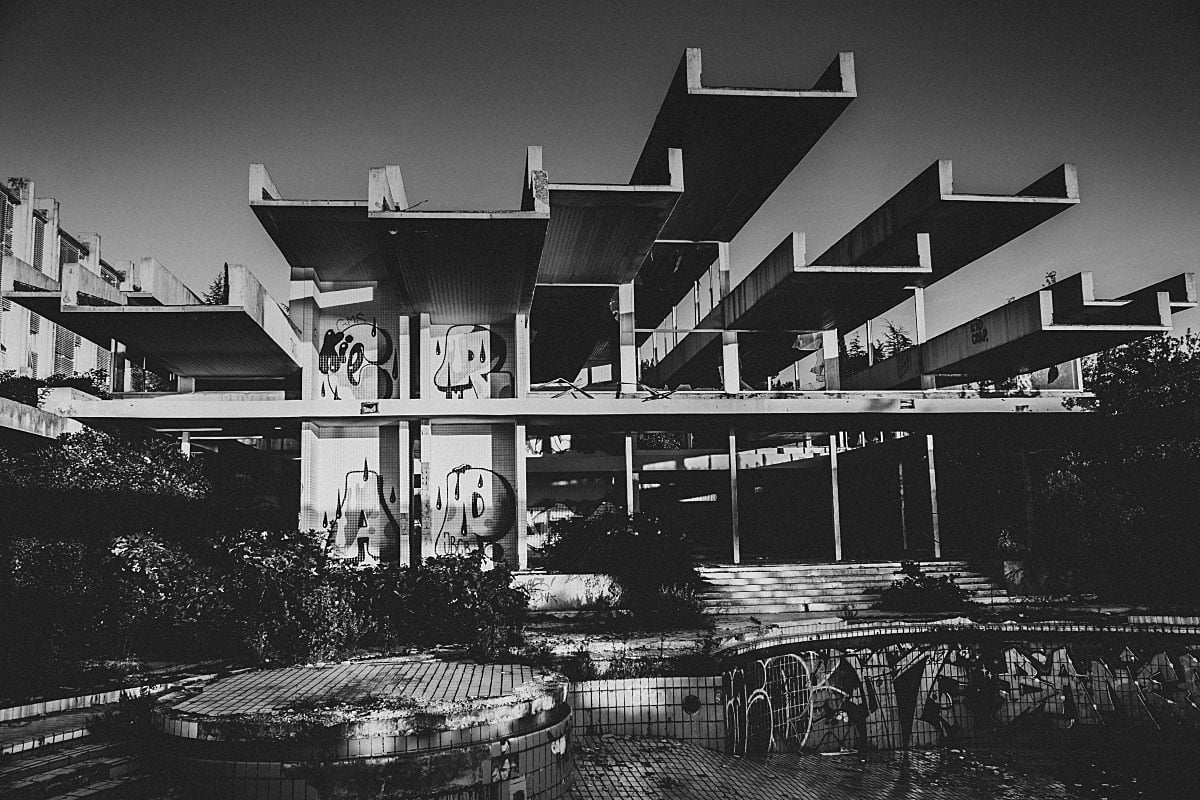




Ian took me to Krk for a day trip, and the island gave us green surroundings, beaches and small old towns to explore. Near Malinska, a large building appeared through the trees: Haludovo Palace Hotel. Vegetation was already creeping across the path to the abandoned hotel. I was curious enough to keep walking, even as the broken glass and empty rooms made this a very different stop from the seaside outing I had imagined.

Haludovo in brief: The Palace is the abandoned centerpiece of a resort designed by Croatian architect Boris Magaš. Its association with Bob Guccione and the Penthouse Adriatic Club made it internationally famous in 1972. The wider Haludovo area, its beach and the derelict hotel building need to be considered separately when planning a visit.
Contents
- Inside Haludovo Palace Hotel
- Haludovo Before the Ruins: A Resort Built Around Leisure
- Bob Guccione and the Penthouse Adriatic Club
- Why Was Haludovo Abandoned?
- Haludovo Today: The Palace, the Beach and Redevelopment
- Practical Details for Haludovo in Malinska
- What Stayed With Me
- Haludovo Palace Hotel FAQ
- Sources
Inside Haludovo Palace Hotel
The empty corridors were the unsettling part. Broken glass lay around the devastated interior, and the passages toward the guest rooms seemed much darker than the open spaces we had just crossed. When a noise came from another part of the building, my heartbeat immediately picked up. A bird, the wind or another curious visitor would have been a perfectly reasonable explanation. Knowing that did very little for my nerves.

The main hall changed the mood completely. Sunshine reached into the open design, and the wind moved through the building and its greenery. This was my favorite part of the ruins: a lobby that still had a sense of space, despite everything it had lost. The dark corridors made me want to leave; here, I wanted to look a little longer. Nature was reclaiming the hotel, and the result was both beautiful and uncomfortable to stand in.

Our photographs record that encounter with the abandoned building. They are not a guide to a maintained visitor attraction, and the condition of the interior should never be judged from an appealing photograph alone.
Haludovo Before the Ruins: A Resort Built Around Leisure
Haludovo was conceived as a whole resort, with the Palace at its center. Boris Magaš developed the complex between 1969 and 1972, giving Malinska an ambitious piece of Croatian tourism architecture. The hotel, villas and coastal Ribarsko selo, or Fishermen’s Village, formed different parts of the same holiday setting. That broader plan helps explain why the name Haludovo refers to more than the single building in our photographs.

A historical pool photograph shows the hotel in a very different condition. Looking from that image to the empty spaces we photographed makes the loss easier to understand. The architecture was planned for people on vacation, with places to gather, swim and spend time outdoors. Without the guests and the daily work of running a hotel, the scale of those spaces becomes strangely exposed.

The Architect Behind the Hotel
Magaš also designed the Solaris hotels near Šibenik and Split’s Poljud stadium. His Haludovo project belongs to the wider history of modern architecture on the Adriatic, where large holiday developments changed the coast in the decades after World War II. MoMA’s collection includes Valentin Jeck’s photographs of Haludovo, and its Boris Magaš record connects his work with the exhibition Toward a Concrete Utopia: Architecture in Yugoslavia, 1948–1980. The hotel’s architectural interest extends well beyond its casino story.

Bob Guccione and the Penthouse Adriatic Club
Bob Guccione, the founder of Penthouse, became involved through a partnership with the Rijeka-based company Brodokomerc. The Penthouse Adriatic Club opened at Haludovo in 1972, bringing an international casino identity to a resort in socialist Yugoslavia. Its gambling business targeted foreign visitors, and the magazine’s hostesses became part of its publicity. Guccione supplied the name and promotional ambition that still dominate many accounts of the place.

The combination was unusual enough to attract attention without any help from later legends. Haludovo joined a Yugoslav resort project to an American publisher’s idea of a playground for wealthy travelers. Behind the publicity was a commercial partnership, with all the practical demands of attracting guests and paying for an extensive operation. The Penthouse connection lasted only a short part of the resort’s working life.
The Champagne Pool Story
The best-known legend says that a swimming pool was filled with champagne. It is a memorable image, and it is still repeated in stories about Haludovo. I would treat it as resort folklore, not as an established detail of the hotel’s operation. The architecture, casino partnership and surviving historical photographs already give us plenty to consider without turning every extravagant anecdote into a fact.

Why Was Haludovo Abandoned?
Haludovo’s abandonment followed several stages. The financial crisis of 1973 ended the Penthouse partnership; it did not mark the permanent closure of the Palace. The resort continued receiving holiday guests in the following decades. War, the disruption of tourism, privatization and later neglect all belong to the much longer story of its decline.

During the war in Croatia in the 1990s, Haludovo accommodated refugees. It was privatized in 1995, and the Palace’s final hotel guests are dated to around New Year 2002 in the scholarly study Remembering Haludovo: The Penthouse Years and What Came Later. The empty building we encountered was the outcome of that longer history, not a resort that had stood unused since its casino’s first difficult season.

A Short Timeline
| Period | What happened |
|---|---|
| 1969–1972 | Boris Magaš’s Haludovo resort complex was developed in Malinska. |
| 1972 | The Penthouse Adriatic Club opened through the Guccione–Brodokomerc partnership. |
| 1973 | Financial difficulties brought the Penthouse involvement to an end. |
| 1970s–1980s | Haludovo continued as a holiday resort. |
| 1990s | The resort housed refugees during the war and was privatized in 1995. |
| Around New Year 2002 | The Palace received its final hotel guests. |
| September 2026 reporting | The Palace remained derelict, while some accommodation elsewhere in the wider Haludovo area was operating. |

Haludovo Today: The Palace, the Beach and Redevelopment
The Palace remains a derelict hotel, while the wider Haludovo area has a more mixed picture. A September 27, 2026 report by 24ur, based on an interview with Malinska’s mayor and a response from the investor’s representative, described operating apartments elsewhere in the zone and work on other parts of the site. Those changes do not amount to the Palace reopening.
Redevelopment has been discussed for years, with public access to the waterfront among the points of dispute. In that September report, the investor’s representative said a revised concept would be presented in October. A proposed concept is not a confirmed opening date. No verified reopening date for the Palace was found in the sources checked for this feature.
The local tourist board separately lists Haludovo Beach below the former hotel complex. It describes a roughly 500-meter stretch beside the waterfront promenade, with paths leading into the forest park. Visitors interested in this part of Malinska can enjoy the coastal setting without treating the abandoned hotel interior as the attraction they must enter.
Practical Details for Haludovo in Malinska
Plan around the shoreline and currently accessible public paths. The hotel interior is a deteriorated building, with broken glass among the hazards we encountered. Do not cross barriers or enter restricted areas; check local signs and ask the tourist office about current conditions before setting out.
| Detail | Information checked in October 2026 |
|---|---|
| Place | Former Haludovo Palace Hotel and the surrounding Haludovo resort area |
| Location | Northern side of Malinska, island of Krk, Croatia |
| Type of feature | First-hand photography and hotel history |
| Architect | Boris Magaš |
| Palace hotel status | Derelict; no verified reopening date found |
| Interior visits | No official visitor opening hours, admission arrangements or permission to enter were verified. An accessible doorway does not establish visitor access. |
| Coastal alternative | Haludovo Beach and the waterfront promenade; follow signs and any local restrictions. |
| Local information | Malinska-Dubašnica Tourist Board |
What Stayed With Me
For me, Haludovo was most memorable in the main hall, where sunlight and greenery reached into a place built for an entirely different kind of life. I could appreciate the space and still be uneasy about the ruined corridors beside it. Readers interested in architecture and hotel history will find more here than a story about extravagant parties. The building also leaves a quieter question: how does a place made for so many people become a place with no one responsible for its daily life?
If the history behind a hotel interests you as much as its rooms, our hotel history features explore other properties and the people, ambitions and changes that shaped them.
Haludovo Palace Hotel FAQ
Where is Haludovo Palace Hotel?
Haludovo Palace Hotel is on the northern side of Malinska, on the Croatian island of Krk. It stands within the wider Haludovo resort area, above the coast.
Is Haludovo Palace Hotel open?
The Palace remains derelict. Some accommodation elsewhere in the wider Haludovo area has returned to use, which should not be confused with the Palace reopening. No verified reopening date was found.
Why did Haludovo close?
Its decline unfolded over decades. Financial trouble ended the Penthouse partnership in 1973, and the resort continued operating afterward. War, privatization and subsequent neglect contributed to its eventual abandonment.
Can you go inside Haludovo?
We have not verified official visitor access to the interior. Our visit revealed broken glass and a devastated building. Stay on accessible public routes, respect barriers and restrictions, and check current conditions locally.
Who designed Haludovo?
Croatian architect Boris Magaš designed the Haludovo complex, developed between 1969 and 1972. His other major works include the Solaris hotels near Šibenik and Poljud stadium in Split.
Was the Haludovo swimming pool filled with champagne?
The champagne-filled pool is a widely repeated legend. It should be treated as folklore rather than a verified event in the hotel’s history.
Sources
Architecture and historical context
- Croatian Biographical Lexicon: Boris Magaš. Architect, Haludovo project dates and wider body of work.
- MoMA: Boris Magaš. Collection records for photographs of Haludovo and the Yugoslav architecture exhibition.
- Irena Šentevska and Maroje Mrduljaš: Remembering Haludovo: The Penthouse Years and What Came Later. Comparative Southeast European Studies, 69(4), 2021, pp. 507–533. Partnership, financial difficulties and the final hotel period.
- New East Digital Archive: The story behind Haludovo. Background on the resort, its later history and the champagne-pool legend.
Current status and local visitor information
- 24ur: Interview with Malinska’s mayor and investor response, September 27, 2026. Condition of the Palace, changes elsewhere in the area and redevelopment discussions.
- Malinska-Dubašnica Tourist Board: Beaches. Haludovo Beach, the coastal setting and promenade.

You might also like