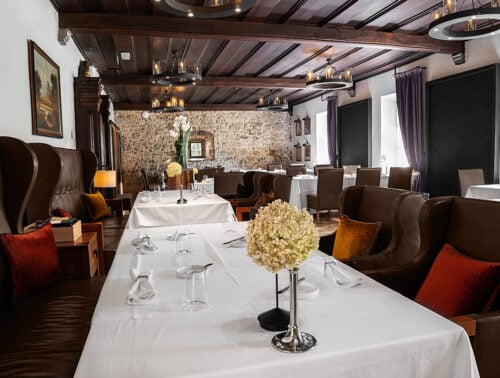
Penang is not short of places to eat Nyonya food, but Kebaya Dining Room promised something different: familiar Straits Chinese flavors handled with fine-dining precision and served inside the beautifully restored Seven Terraces. It could easily have felt like heritage staged for visitors. Instead, our dinner held together, from the patterned tiles and carved furniture to the dishes that arrived at the table.
Editor’s note: We visited Kebaya Dining Room in September 2018. The dishes, opinions and ratings in this review reflect that dinner. The restaurant’s menu, prices and practical information were checked and updated in August 2026.
Contents
- Kebaya Dining Room at a Glance
- Inside Kebaya Dining Room at Seven Terraces
- How the Kebaya Set Menu Works
- Pai Tee and Joo Hoo Char Roll
- Duck Confit and Prawn Geng
- Vegetables That Were Not an Afterthought
- Gula Melaka Mousse and Pengat
- Is Kebaya Dining Room Worth It?
- Our Kebaya Dining Room Ratings
- Current Price, Location and Reservations
- Kebaya Dining Room FAQ
Kebaya Dining Room at a Glance
| Location | Seven Terraces, George Town, Penang |
|---|---|
| Style | Modern Straits Chinese and Nyonya cuisine |
| Current format | Set-menu dinner only |
| Our favorite dish | Prawn Geng |
| Our rating | 9.1/10, based on our 2018 visit |
Inside Kebaya Dining Room at Seven Terraces
Walking into Kebaya was less like entering a conventional restaurant and more like stepping into a carefully preserved Peranakan home. Before we had even opened the menu, our attention was moving from the patterned floor to the carved furniture, porcelain pieces and small decorative details around the room. The setting prepares you for a Nyonya dinner before the first dish reaches the table.

Colorful floor tiles sit beneath substantial wooden furniture, while old tableware and collected objects give parts of the dining room the character of a private collection. Rich fabrics and darker wood make the space formal without tipping into stiff. There is plenty to look at, yet nothing appears to have been added simply to fill an empty corner. The room comes across as layered and lived in, which is much harder to create than an interior that is merely expensive.

Baba Bar continues the visual story instead of introducing a separate style. Dark wood, antique pieces and carefully chosen details connect it to Kebaya, although the mood is slightly more relaxed. Even without stopping for a drink, we enjoyed looking around before continuing to dinner. It came across as a quieter extension of the dining room, not a venue trying to pull attention away from it.

The courtyard introduces a different mood. After the darker wood and richer colors inside, the open space, greenery and natural light offer a pause between the hotel and the restaurant. It also prevents Kebaya from feeling sealed away inside a formal dining room. Passing through the garden turns the arrival into something gradual, as though the evening has already begun before you take your seat.

Back inside, the antiques are more than a decorative backdrop for Nyonya dining. Furniture, ceramics and carved details help explain the culture from which the menu takes its inspiration. Kebaya does not reproduce a historic home exactly, nor does it need to. What matters is that the old pieces and the modern restaurant sit comfortably together instead of competing for attention.

A Sculpture That Changes as You Walk
The courtyard centerpiece gave us a reason to slow down. From one position, the metal outline resembles an elephant; from another, it becomes a giraffe. French sculptor Matthieu Robert-Ortis built the piece entirely around this kind of shifting perspective, and we ended up circling it without first deciding to do so. It is a clever introduction to a property where the angle from which you look at tradition matters.

How the Kebaya Set Menu Works
During our visit, the four-course menu allowed us to choose starters, proteins, vegetables and desserts. The dishes were placed in the middle of the table, so ordering different options gave both of us a wider look at the kitchen. It was a polished version of communal dining, closer to sharing plates than to a sequence of small, individual tasting-menu courses.
The restaurant’s current format is still set-menu only, although the choices and number of courses have changed. Kebaya combines traditional Malaysian flavor profiles with techniques such as confit and sous vide. That modern treatment never bothered me because the dishes still tasted rooted in Peranakan culture, not simply borrowing its name for decoration.
Pai Tee and Joo Hoo Char Roll
We began with Pai Tee, a dish we already knew and were happy to meet again. The crisp shells held julienned vegetables and sweet chili, giving each bite crunch, sweetness, acidity and a little heat. They were awkward to eat neatly, but that became part of the fun. Pai Tee has a way of making formal dining less formal for a minute.

The Joo Hoo Char Roll was more composed but no less interesting. Carrot, shiitake, pork and dried squid were wrapped in rice paper and fried, then served with lettuce and a smoky sauce carrying sour and spicy notes. Wrapping the roll in lettuce before dipping it softened the richness without taking away its crunch. Between the two starters, this was the one with greater depth.

Duck Confit and Prawn Geng
Lor Ark brought duck confit together with plums, orange, cinnamon, star anise, cloves and nutmeg. There was a lot going on in the gravy, yet the duck did not disappear beneath the spices. The meat was tender, the sauce was deep and aromatic, and the result had little in common with the familiar European pairing of duck with orange.

Good as the duck was, Prawn Geng became my favorite dish of the night. Wild prawns sat in a coconut-based curry scented with turmeric and lemongrass. The gravy was salty enough to sharpen the sweetness of the prawns, but not so forceful that every spoonful tasted the same. I kept returning to it long after I had finished forming a sensible opinion.


Vegetables That Were Not an Afterthought
The vegetable dishes did more than occupy the space beside the proteins. Nyonya belachan tempura brought together sweet potato, young corn and zucchini in a delicate batter dusted with the restaurant’s belachan chili seasoning. It was crisp rather than greasy, while the vegetables retained enough moisture to avoid becoming little more than fried batter.
A second plate of greens and mushrooms was quieter but useful against the richer sauces. Soy, oyster and fish sauce supplied plenty of umami, yet the vegetables still had a clean flavor and a pleasantly firm texture.

Gula Melaka Mousse and Pengat
Dessert did not arrive merely to close the menu. The Gula Melaka mousse was layered over sponge cake and finished with candied nuts. Palm sugar gave it a warm caramel depth, while the nuts interrupted the softness with just enough crunch. It brought back memories of the Gula Melaka dessert we had enjoyed at Wild Coriander in Melaka, although Kebaya’s version was more polished.


Our second dessert, Pengat, was more playful: coconut ice cream with jackfruit puree, pandan jelly, sweet potato dumplings and banana chips. The puree briefly reminded me of mango before the unmistakable jackfruit flavor appeared. Creamy, chewy and crisp textures met in one bowl, and the coconut kept the stronger fruit from dominating it.

Is Kebaya Dining Room Worth It?
For us, yes. Kebaya succeeded because the room and the food told the same story without turning dinner into a history lesson. The kitchen used modern techniques, but the flavors remained generous and recognizably Nyonya. Prawn Geng was the dish that stayed with me, although the Joo Hoo Char Roll and both desserts were close behind.
This is not the place for someone looking for an inexpensive, spontaneous hawker meal or complete freedom to order à la carte. It suits a slower evening, preferably with another diner who is willing to choose different dishes and share. I left more interested in Peranakan cuisine than I had been when we arrived, which is about as useful a compliment as I can give a restaurant.
Pros
- The richly detailed Peranakan setting
- Prawn Geng and its turmeric-and-lemongrass curry
- The smoky sauce served with the Joo Hoo Char Roll
- Vegetable dishes treated with as much care as the proteins
- Two memorable desserts
Cons
- Pai Tee was difficult to eat neatly
- The portion of Prawn Geng left us wishing there had been more to share

Our Kebaya Dining Room Ratings
These ratings reflect our September 2018 dinner, including the menu and value we experienced at the time.
- ATMOSPHERE – 9/109/10
- SERVICE – 8.8/108.8/10
- PRESENTATION – 9/109/10
- FOOD – 9.4/109.4/10
- DRINKS – 9/109/10
- VALUE – 9.2/109.2/10
Current Price, Location and Reservations
Kebaya now serves dinner by set menu only. The current guide published by the Seven Terraces hotel group lists a two-course menu at RM 138+ (about US$34 before tax) and a three-course menu at RM 158+ (about US$39 before tax) per person. These are not the prices from our 2018 visit and may change, so check them again when booking.
| Practical detail | Current information |
|---|---|
| Set-menu price | Two courses: RM 138+ (about US$34 before tax) Three courses: RM 158+ (about US$39 before tax) per person |
| Opening hours | Dinner daily, 6:00pm–10:30pm |
| Seating times | 6:00pm and 8:00pm |
| Address | 14A Stewart Lane, 10200 George Town, Penang |
Reservations can be requested through the official Kebaya Dining Room website. Its online form is a request rather than an instant confirmation; the restaurant advises calling if you need immediate confirmation. For directions, open Kebaya Dining Room in Google Maps.
Kebaya Dining Room FAQ
Does Kebaya Dining Room serve an à la carte menu?
No. The restaurant currently serves a set menu only, with a minimum order of one set per person.
Do you need a reservation at Kebaya Dining Room?
Booking ahead is sensible, especially for weekends. You can submit a request online, email the restaurant or call directly. An online request is not confirmed until the restaurant replies.
What is the dress code at Kebaya Dining Room?
The official restaurant website does not currently publish a formal dress code. Smart casual clothing is a comfortable choice for the elegant dining room, but that is a suggestion rather than a stated requirement.
Is Kebaya Dining Room halal?
No. Kebaya Dining Room is not halal-certified, and pork appears on the menu.
Are vegetarian options available?
Yes. The restaurant asks guests to communicate special dietary requirements when booking, and the Michelin Guide listing also notes vegetarian choices. Confirm the current selection and any allergies directly with the restaurant.
Does Kebaya Dining Room have a Michelin star?
No. Kebaya Dining Room is listed in the Michelin Guide, but it does not hold a Michelin star.

You might also like