Few hotels have watched a city change as closely as Mandarin Oriental, Bangkok. Its story reaches back to the years when Bangkok was still a river port in the Kingdom of Siam, foreign ships arrived along the Chao Phraya and a comfortable room with electric light was newsworthy. The hotel survived fire, uncertain ownership, two world wars and periods when its elegance was more memory than reality.
It also welcomed royalty, diplomats, writers and some wonderfully stubborn hoteliers who repeatedly refused to let the old place disappear. This complete Mandarin Oriental Bangkok history follows that transformation from a modest riverside lodging to The Oriental, and eventually to one of the two hotels that gave the Mandarin Oriental group its name. For our experience of the hotel today, read our Mandarin Oriental Bangkok hotel review.
Contents
- The Early Days: 1862-1881
- Danish Owners and the Birth of the Authors’ Wing
- Royal Guests and Electric Light
- Writers at The Oriental
- The Paknam Incident and Changing Owners
- Maria Marie and a New Golden Era
- Between the Wars: Renewal and New Connections
- War, Occupation and a Difficult Revival
- Jim Thompson, Germaine Krull and the Garden Wing
- The River Wing and Mandarin International
- From The Oriental to Mandarin Oriental
- Restoring the Authors’ and Garden Wings
- The River Wing Reimagined in 2019
- Preparing for the 150th Anniversary
- Conclusion: A Hotel Built in Layers
- Mandarin Oriental Bangkok History FAQ

The Early Days: 1862-1881
The riverside land associated with the hotel had strong royal connections. A residence belonging to Prince Krom Muen Bhubet Bhumipet, a son of King Rama II, once stood in this area. Nearby, Captain James White opened a boarding house for foreign seafarers in the early 1860s. After his death, the business passed to the Americans Atkins Dyer and William West, who developed it into an early version of the Oriental Hotel.
That first establishment did not last. A major fire swept through the riverside district in 1865 and destroyed the hotel along with dozens of surrounding buildings. The name survived, however. C. Falck, a German proprietor, opened Falck’s Hotel in 1866, complete with the rather unexpected novelty of a bowling alley. Later in the 1870s, Danish seaman C. Salje took over and introduced family accommodation, bathrooms, a billiards room and an American Bar. The simple boarding house was gradually learning how to behave like a Western hotel.


Danish Owners and the Birth of the Authors’ Wing
In 1881, Salje and his business partner H. Jarck retired and sold their interests to another Dane, Hans Niels Andersen. Together with P. Andersen and F. Kinch, he established Andersen & Co. Their business extended well beyond bedrooms. It included the Oriental Store and ship chandlery, a bakery, an aerated-water factory and other commercial interests linked to the busy river trade.
The decisive architectural change came when the owners commissioned the Italian partnership of Stefano Cardu and Rosario to design a grand new hotel building. Completed in 1887, it offered a level of comfort and ceremony that earlier versions of The Oriental could not match. This elegant riverside structure survives as the Authors’ Wing and remains the historical heart of Mandarin Oriental, Bangkok.

The hotel soon became more than a place to sleep. It catered important receptions, welcomed travelers arriving by river and developed into one of Bangkok’s social landmarks. Contemporary descriptions praised it as one of the finest places to stay in the East, although such claims were easier to make before online guest reviews arrived to keep everyone humble.


Royal Guests and Electric Light
King Chulalongkorn visited The Oriental privately in December 1890. The hotel evidently made a convincing impression because it was selected to accommodate Crown Prince Nicholas of Russia during his visit to Siam in April 1891. The future Tsar Nicholas II arrived as a royal guest, and the occasion strengthened the hotel’s long relationship with the Thai royal family.

The Russian delegation reportedly made a determined effort to empty the hotel’s drinks supply. More importantly for the history of hospitality, electric lighting was installed in April 1891. At the time, electric light remained rare in Bangkok and was found in only a handful of prominent locations, including the Royal Palace. The Oriental was becoming modern while much of the city was still finding its way into the electrical age.

Writers at The Oriental
The literary connection now used so naturally in the hotel’s identity was built guest by guest. Some writers stayed before they were famous, while others arrived with reputations already large enough to fill the lobby. Their experiences were not always romantic. Tropical heat, illness and long journeys also found their way into the story.
Joseph Conrad
Joseph Conrad arrived in Bangkok in 1888 as a sea captain rather than a celebrated novelist. His life at sea later fed the atmosphere and moral complexity of his fiction, including Lord Jim. The hotel’s riverside restaurant would eventually borrow the title, ensuring that Conrad remained present even when most guests were thinking more about dinner than literary modernism.

Maxwell Sommerville
American scholar and collector Maxwell Sommerville stayed in 1897 and left a detailed account of the hotel. He and his wife admired comforts that were far from guaranteed during travel in the region, including the simple luxury of two sheets on a bed. He also recorded an extraordinary dinner selection of mangosteens, breadfruit, oranges, custard apples, papaya, pineapples, mangoes, bananas and durian. Long before hotel breakfasts became social-media performances, The Oriental already understood the value of an impressive fruit display.

W. Somerset Maugham
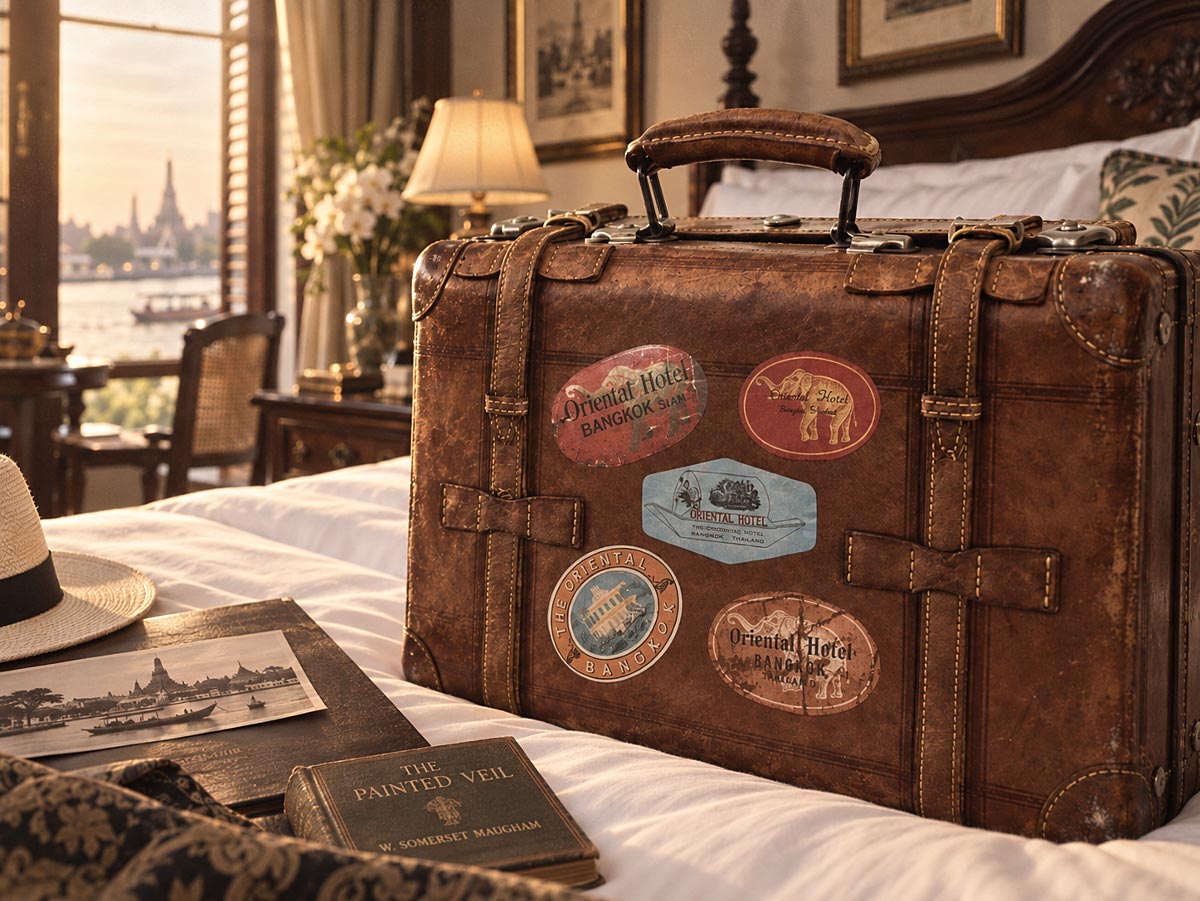
W. Somerset Maugham’s first stay was less comfortable. He arrived suffering from malaria and later described the hotel and his illness in The Gentleman in the Parlour. According to the story he enjoyed repeating, the manager was deeply concerned that his death in one of the rooms might be bad for business. Maugham recovered, returned to the hotel and eventually celebrated his 85th birthday there in 1960, when he dined with Jim Thompson.


Later guests included Noël Coward, James Michener, Barbara Cartland and John le Carré, who worked on The Honourable Schoolboy at the hotel. The Authors’ Wing, Authors’ Lounge and literary suites are therefore more than decorative branding. They preserve a relationship between travel and writing that grew over more than a century. Our Authors’ Lounge afternoon tea review explores how that legacy feels today.
The Paknam Incident and Changing Owners
The hotel’s comfortable verandas could not isolate it from the politics of empire. In 1893, tensions between Siam and French Indochina reached a crisis during the Paknam Incident. French warships forced their way toward Bangkok and later anchored near the French Legation and The Oriental. Siam avoided a wider war but accepted a substantial indemnity and territorial concessions.

That same year, H. N. Andersen sold the hotel to Franklin Bill Hurst for $22,000 while retaining the neighboring Oriental Store. Andersen returned to Denmark and played an important role in the East Asiatic Company. Hurst placed American W. J. Palmer in charge, and Palmer ended the loose credit system that had allowed some guests to sign a chit and postpone payment with admirable optimism.


The late 1890s and early 1900s brought another sequence of owners and managers. Hurst sold his interest in 1899, and the hotel passed through a turbulent period before closing temporarily. American Carl G. Edwards helped revive it in 1905 and appointed Madame M. O. Bujault to manage the property. She engaged a Viennese orchestra, restored the tradition of musical dinners and hired the French chef Monsieur Brier. Food once again became central to The Oriental’s reputation.

Maria Marie and a New Golden Era
Madame Bujault managed the hotel until 1910 and was followed by Maria Marie, one of the most important figures in its early history. Under her direction, The Oriental regained its place as a social center for travelers, diplomats and businesspeople. Peter Carl Fabergé exhibited at the hotel, and King Vajiravudh, Rama VI, became one of his clients.


In 1913, the Imperial and Royal Austro-Hungarian Legation established its chancery at the hotel. The arrangement reflected The Oriental’s standing in diplomatic Bangkok, although Europe’s political order soon collapsed into World War I. Long-distance luxury travel declined, and the hotel once again faced difficult years.

Between the Wars: Renewal and New Connections
By 1920, the hotel’s condition had declined badly enough to attract public criticism. Journalist Henri Cucherousset complained about the lack of a proper ladies’ drawing room, inadequate bathing facilities and a generally tired appearance. The response was energetic. New capital was raised, Maria Marie became a shareholder and managing director, and renovations restored much of the hotel’s former standing.

The renovation coincided with a changing culture of travel. Railways opened more of Siam to visitors, while aviation slowly shortened the journey from Europe. The first group of air travelers arrived at Don Muang in 1931, and The Oriental began welcoming guests who had reached Bangkok by air rather than sea. Their journey from London could still take around nine days, so nobody was yet complaining about a three-hour connection.

Maria Marie was also a successful golfer. Her connection with the sport became personal when she married Scottish railway engineer and golf-course designer Arthur O. Robins in London in 1932. After more than two decades at The Oriental, she retired and placed Lieutenant Colonel and Mrs. Sylow in charge.


The political landscape was changing too. The 1932 revolution ended Siam’s absolute monarchy, and the country adopted its first constitution. In 1939, Siam officially became Thailand. The old hotel had already lived through several versions of Bangkok, and another far more dangerous transformation was approaching.

War, Occupation and a Difficult Revival
During World War II, Japanese forces requisitioned The Oriental. In 1942, its management was placed under the supervision of Tokyo’s Imperial Hotel. Bangkok was bombed during the later years of the conflict, and after the war The Oriental was used by American forces. The building survived, but its interiors and finances were in poor condition.


Even in those unsettled years, journalists and correspondents gathered on the terrace to exchange stories over cold drinks. Among them was American intelligence officer and future silk entrepreneur Jim Thompson. His friendship with photographer Germaine Krull would soon pull both of them into the hotel’s next chapter.
Jim Thompson, Germaine Krull and the Garden Wing
Krull was already an accomplished photographer whose subjects included Jean Cocteau, André Malraux, Charles de Gaulle and Winston Churchill. Thompson suggested that they help take over and revive The Oriental. Their partnership included General Chai Prateepasen, Prince Bhanu, Pote Sarasin and John Wester. By May 1947, Krull was managing the hotel and working to restore life to what was affectionately described as the old lady.

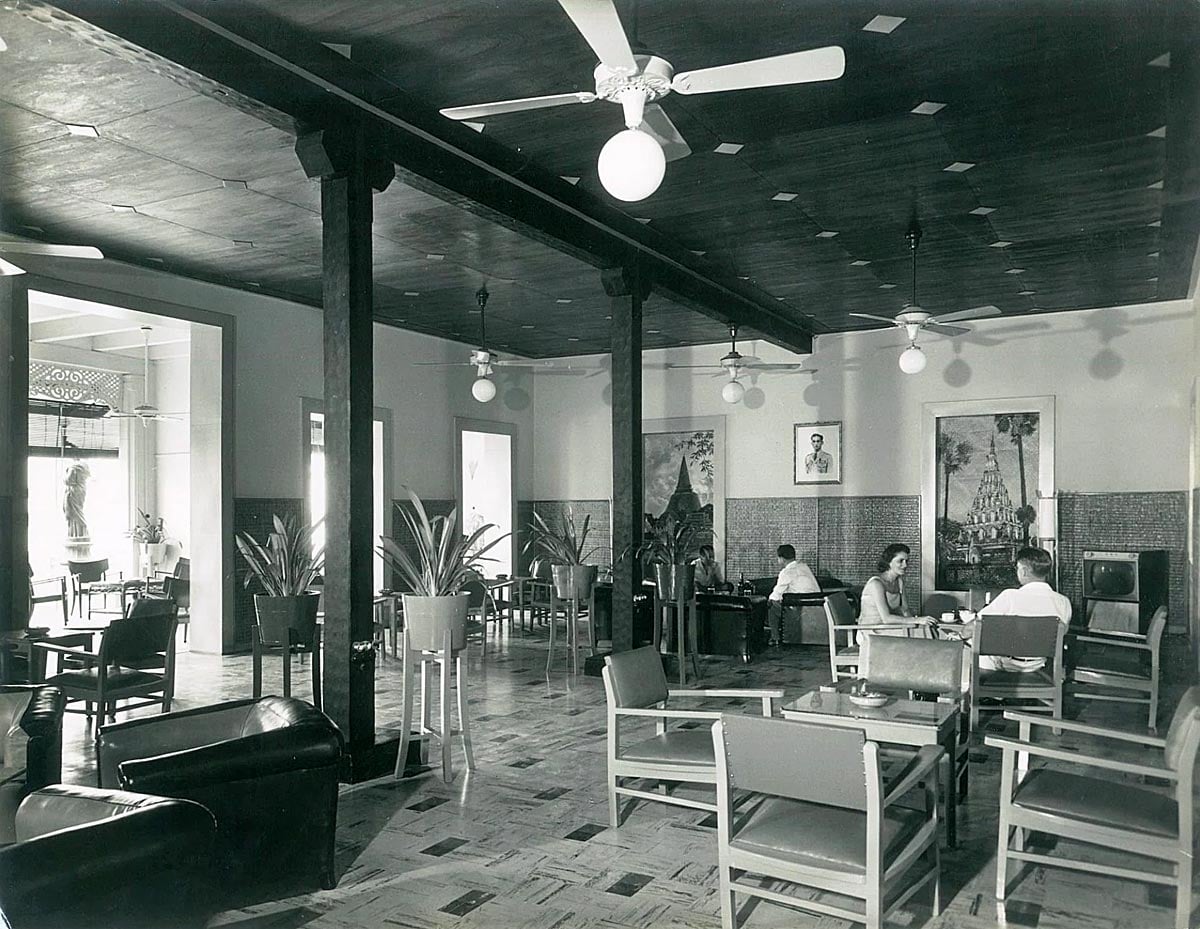
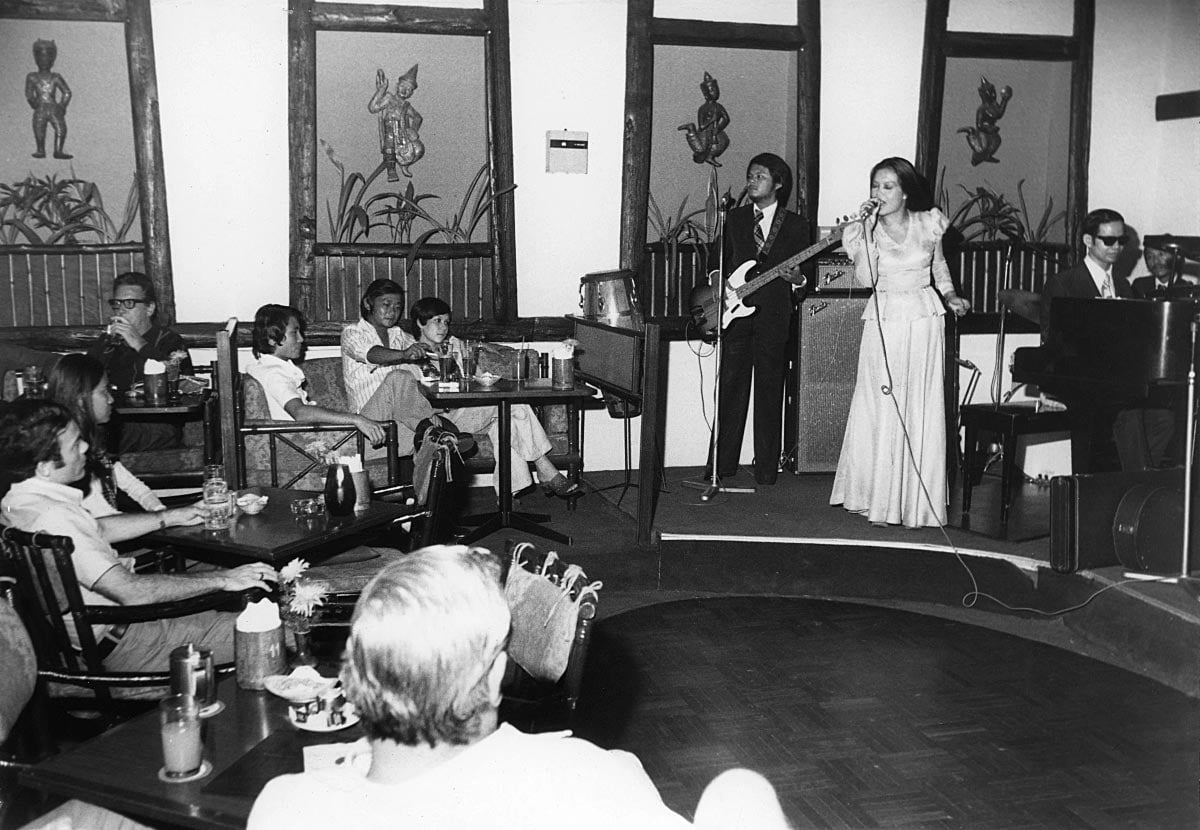
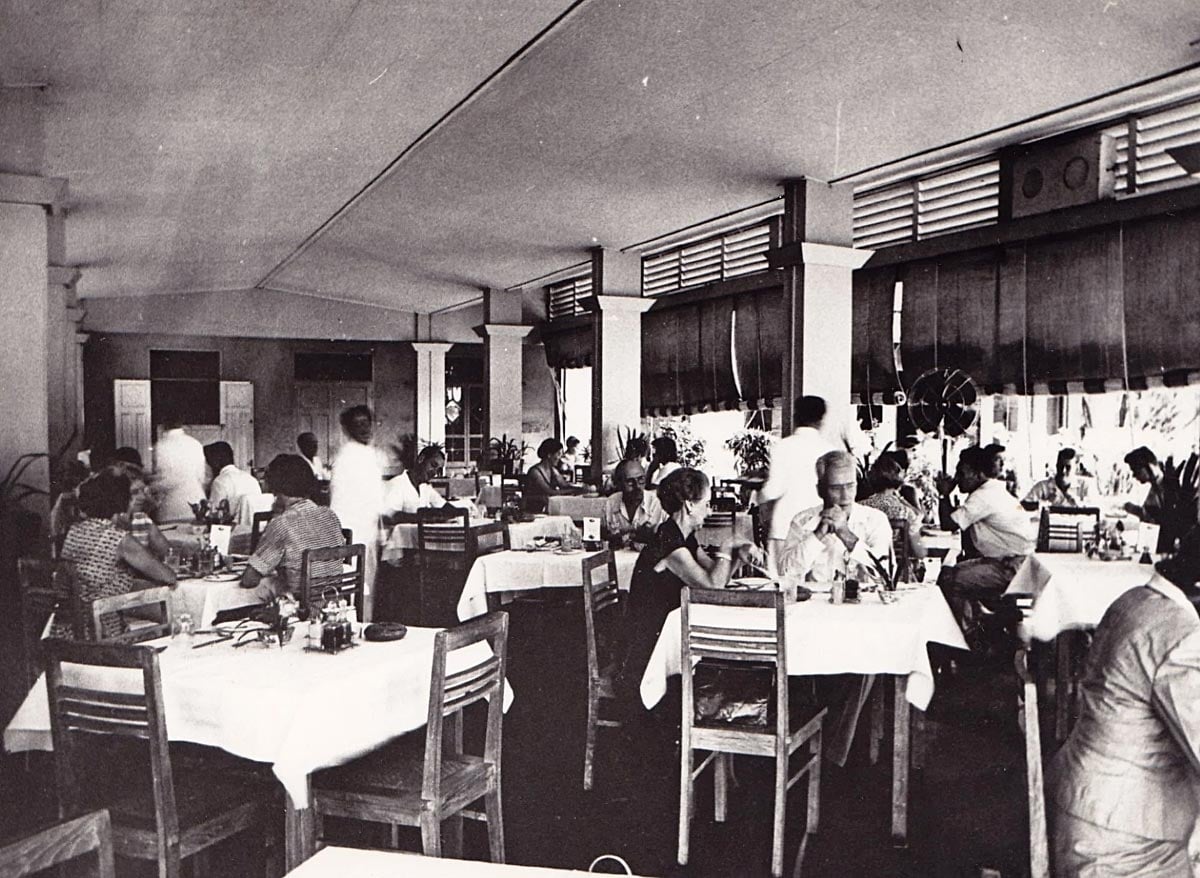
One of Krull’s early successes was the Bamboo Bar, which opened with live music and a menu of American sandwiches, hot dogs, hamburgers and fried chicken. Bangkok had changed during the war, and the bar quickly became a fashionable meeting place. It remains part of the hotel today, although the cocktails are considerably more ambitious.
Krull and Thompson eventually disagreed over the hotel’s architectural direction, particularly plans for a new wing. Thompson sold his interest and concentrated on the Thai silk business that would make him famous. The ten-story Garden Wing opened in 1958, bringing elevators, more modern accommodation and Le Normandie to the property. The new structure changed the hotel’s silhouette, but the old Authors’ Wing remained beside it as a visible reminder of the nineteenth century.

The River Wing and Mandarin International
Another influential figure arrived in 1967 when 30-year-old Kurt Wachtveitl became general manager. He would remain in charge until 2009, an extraordinary period of continuity during which Bangkok expanded rapidly and The Oriental grew from a distinguished local institution into an internationally recognized luxury hotel.
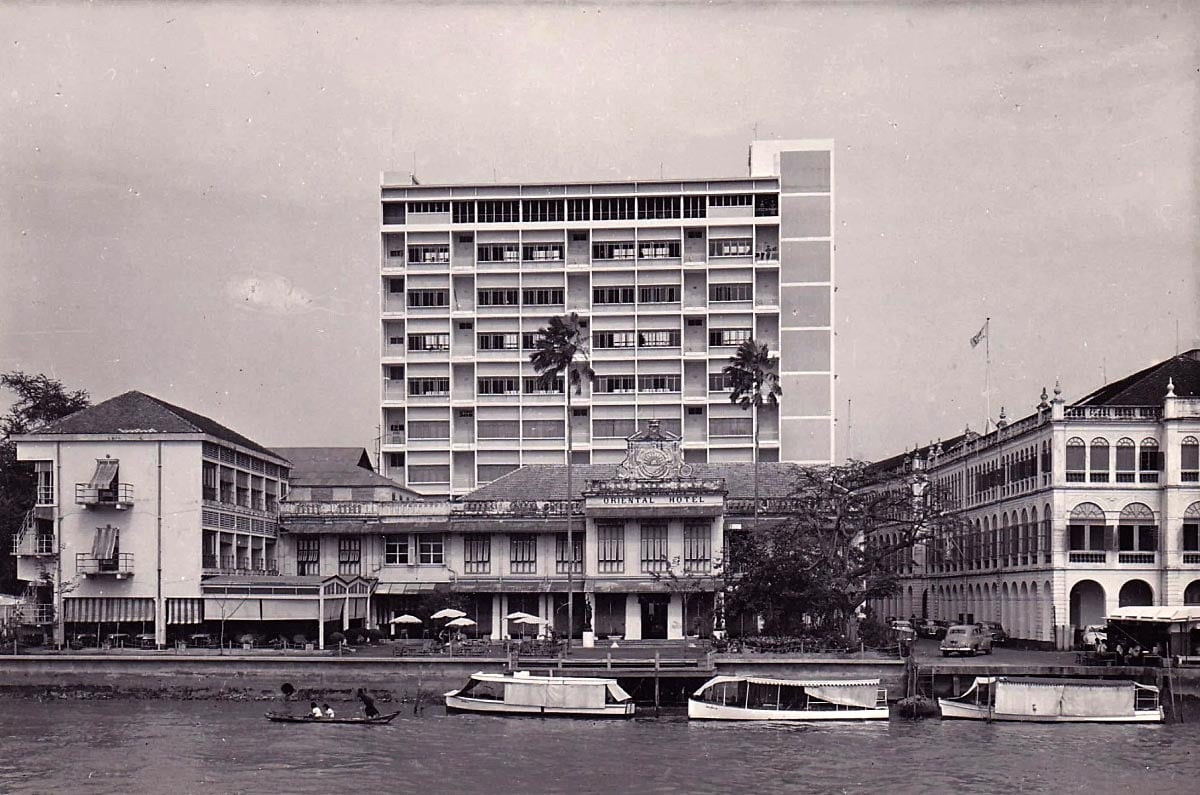
The hotel acquired neighboring land in the early 1970s for a far larger addition. In 1974, Mandarin International Hotels Limited acquired a 49 percent interest in The Oriental. Two years later, the new River Wing opened with approximately 350 rooms and a new main lobby. The modern tower transformed the scale of the property and placed most guests directly above the Chao Phraya, while the Authors’ Wing retained the intimate atmosphere of the old hotel.
The 1976 opening also helped settle a surprisingly complicated question: how old was The Oriental? Its roots could be traced to the early 1860s, the first hotel had burned down in 1865 and the surviving Authors’ Wing was completed in 1887. The board adopted 1876 as the official establishment date and celebrated the hotel’s centenary alongside the River Wing opening. The date may contain a little poetic license, but it has defined every major anniversary since.
From The Oriental to Mandarin Oriental
The Bangkok hotel did not simply join an existing brand. Together with The Mandarin in Hong Kong, it helped create one. In 1985, the identities of the group’s two flagship hotels were combined under the Mandarin Oriental name. The fan logo and the dual heritage of Hong Kong and Bangkok became the foundation for the company’s international expansion.
The property continued to add new experiences while preserving The Oriental name in familiar places. The Oriental Spa opened across the river in 1993, reached by the hotel’s boat, and helped establish the group’s reputation for hotel wellness. The official hotel name changed much later. In 2008, The Oriental, Bangkok formally became Mandarin Oriental, Bangkok. For many returning guests and longtime employees, however, it remained simply The Oriental.
Restoring the Authors’ and Garden Wings
A major restoration began in 2015 and was completed for the hotel’s 140th anniversary in 2016. The project focused on the historic Authors’ Wing and the neighboring Garden Wing, the two parts of the property where its past could most easily have been polished into something generic.
Instead, the Authors’ Lounge was restored with the character of its late nineteenth-century setting in mind. Room layouts were reorganized to create larger accommodations, including the six-bedroom Grand Royal Suite in the Authors’ Wing and 12 suites with balconies in the Garden Wing. The restoration also refreshed Le Normandie and introduced the group’s first Spa Studio. Modern comforts were added, but the white facades, fretwork, literary portraits and quiet formality remained recognizable.
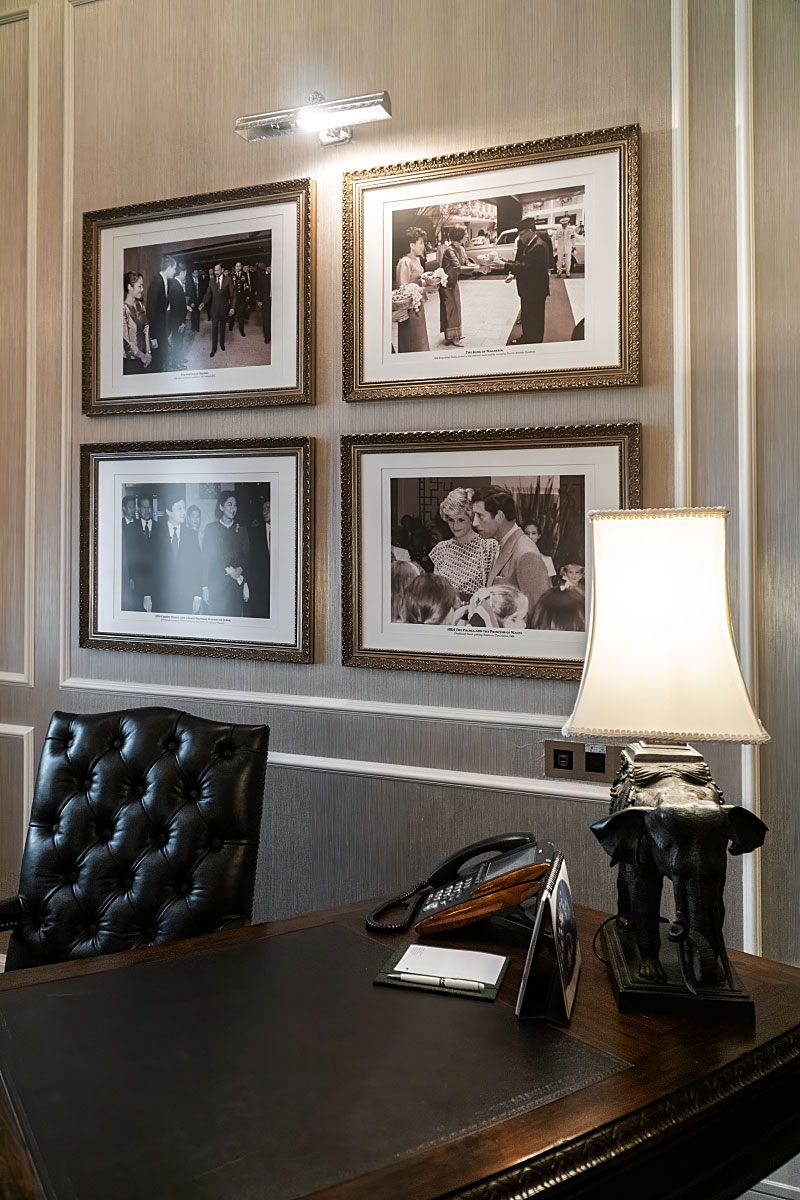
This was an important change in philosophy. The 1958 and 1976 additions had expanded the hotel outward and upward. The 2016 project turned inward, treating historical atmosphere as something worth conserving rather than a charming obstacle to redevelopment.
The River Wing Reimagined in 2019
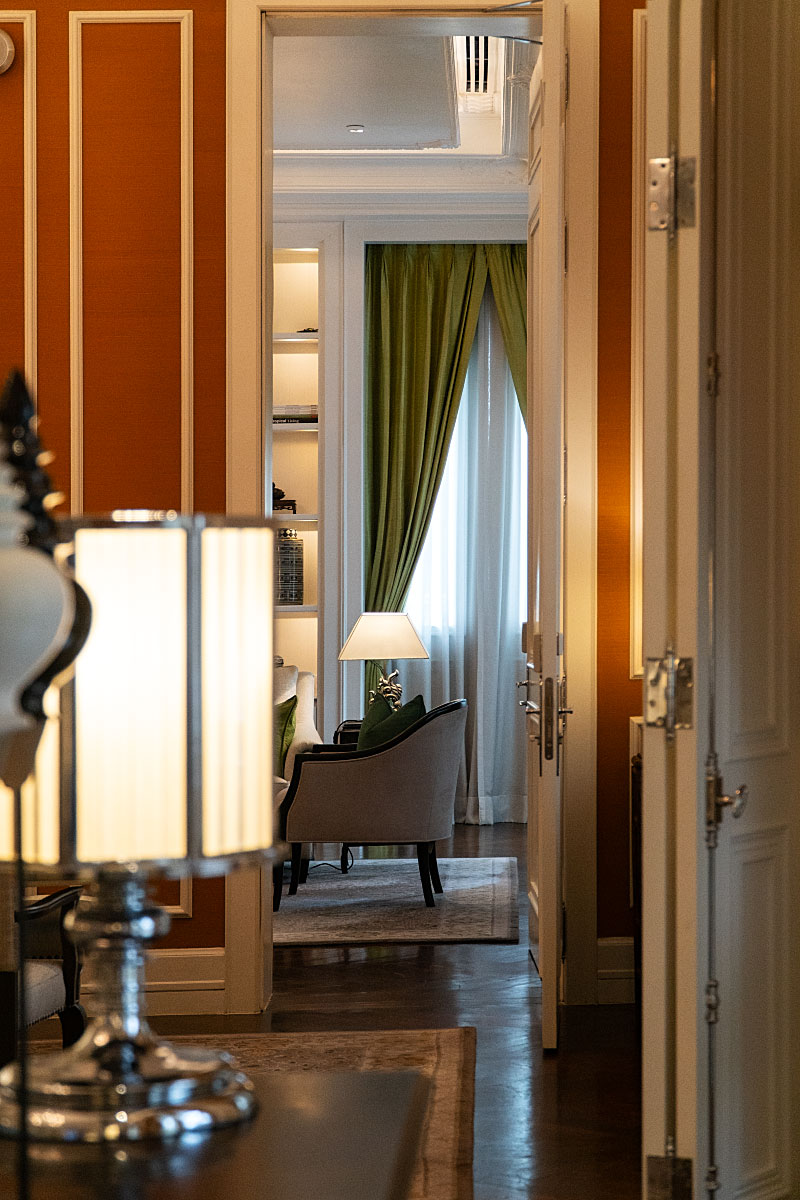
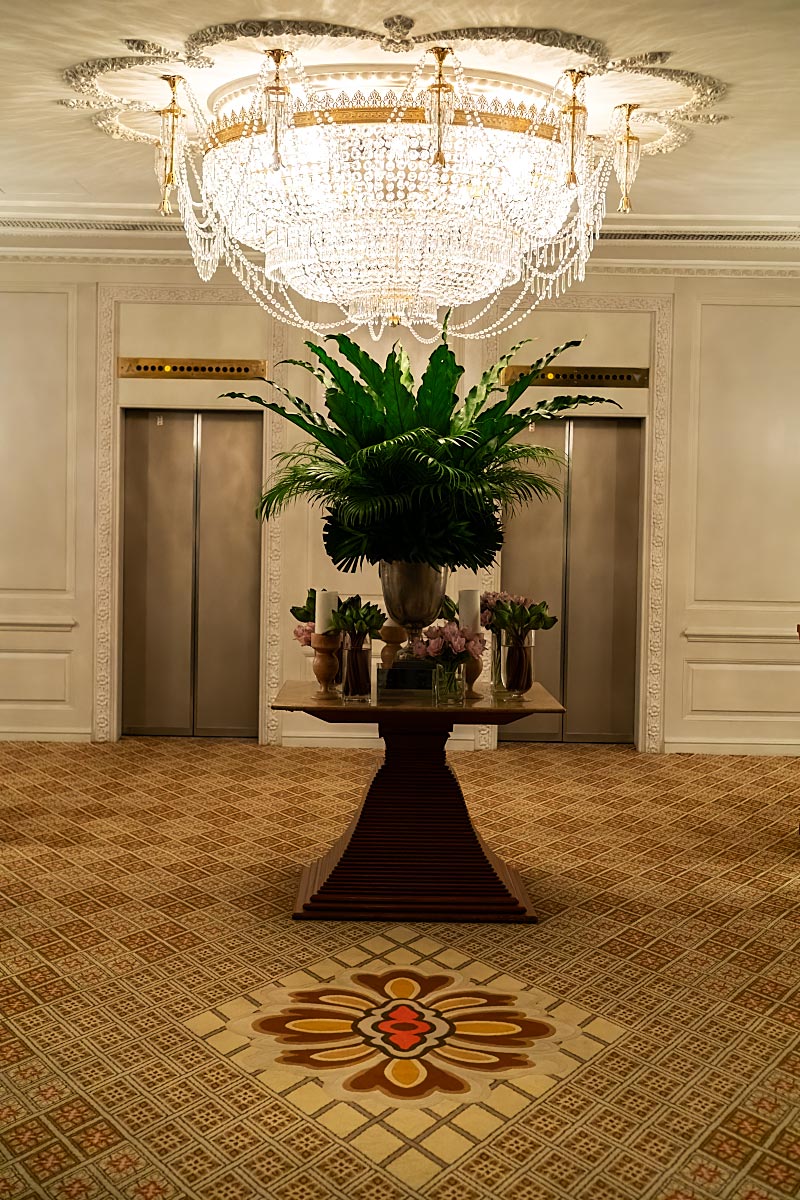
The River Wing received its own transformation three years later. It reopened on 11 November 2019 after what the hotel described as the most extensive restoration in its 143-year history. Designer Jeffrey Wilkes reworked the rooms and suites, lobby and several restaurants, reducing the number of rooms while increasing the proportion and size of suites.
The renovation used contemporary Thai details rather than attempting to make the 1970s tower resemble the nineteenth-century Authors’ Wing. Its strongest historical connection came through materials. Of the 294 fabrics selected by Wilkes, 189 came from Jim Thompson, bringing the former owner’s silk legacy back into the building he had once argued about.
We wrote about the renovation as it was approaching and allowed ourselves to imagine a rather more theatrical alternative involving a Victorian riverside conservatory. The hotel sensibly followed its own plans. Our independent concept remains in Mandarin Oriental Bangkok Renovation: The Glasshouse I Imagined, while the completed River Wing became the modern face of the hotel.
Preparing for the 150th Anniversary
The next program was announced in 2025 as the hotel prepared to celebrate 150 years from its official 1876 establishment date. Jeffrey Wilkes returned to redesign guest accommodations in the Authors’ and Garden Wings, drawing on the tropical gardens, Thai craftsmanship and stronger colors than those normally associated with anonymous international hotel rooms.
The work extended beyond bedrooms. Le Normandie was transformed for the arrival of Anne-Sophie Pic, Lord Jim’s received a new culinary direction with Alex Dilling, The China House was redesigned for Chef Fei and Baan Phraya entered a new chapter under Chef Pom. The Fitness Centre was also fully reworked. By the anniversary year, the hotel’s rooms and suites had been refreshed across its different wings, creating a rare moment when almost every period of the property could be read in newly finished interiors.
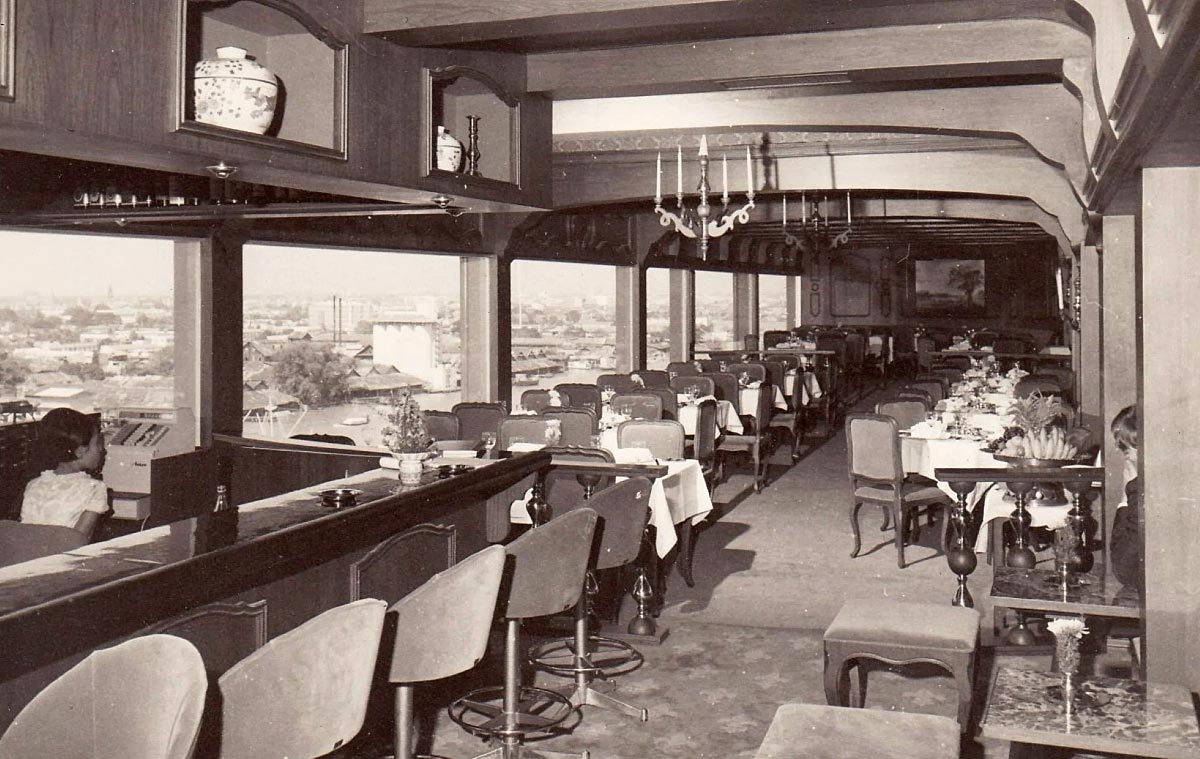
In 2026, Mandarin Oriental, Bangkok marked its 150th anniversary. The celebration honored the official date rather than the earliest possible beginning, yet that hardly diminishes the achievement. The hotel had survived precisely because each generation was willing to change something: rebuild after a fire, add a wing, restore an old room, rethink a restaurant or return a nineteenth-century lounge to prominence.
Conclusion: A Hotel Built in Layers
Mandarin Oriental, Bangkok is often described as timeless, but that word can hide the more interesting truth. The hotel has changed repeatedly. The Authors’ Wing, Garden Wing and River Wing come from different periods and answer different ideas of what a great hotel should be. Their survival together is what gives the property its character.
The name changed, the room count changed and generations of managers came and went. The river, the royal connections, the writers and the memory of The Oriental continued to hold the layers together. Our Mandarin Oriental Bangkok review explains what it feels like to stay within that history today, while afternoon tea in the Authors’ Lounge remains the simplest way to enter it without checking in.
Mandarin Oriental Bangkok History FAQ
When was Mandarin Oriental Bangkok founded?
The hotel uses 1876 as its official establishment date, although its roots reach back to an earlier Oriental Hotel opened in the 1860s. The surviving building now known as the Authors’ Wing was completed in 1887.
When did The Oriental become part of Mandarin Oriental?
Mandarin International Hotels Limited acquired a 49 percent interest in The Oriental in 1974. The Mandarin Oriental group name was created from its Bangkok and Hong Kong flagships in 1985, while the Bangkok hotel was formally renamed Mandarin Oriental, Bangkok in 2008.
When was the River Wing built?
The River Wing opened in 1976 and introduced a much larger number of river-facing rooms as well as a new main lobby. It underwent an extensive renovation in 2019 and reopened on 11 November that year.
Is the Authors’ Wing the original hotel building?
The Authors’ Wing is the oldest surviving hotel building on the property. It was completed in 1887, restored for the hotel’s 140th anniversary in 2016 and refreshed again as part of the work leading into the 150th anniversary.
Which famous writers stayed at The Oriental Bangkok?
The hotel’s literary guests included Joseph Conrad, W. Somerset Maugham, Noël Coward, James Michener, Barbara Cartland and John le Carré. Their connection is remembered through the Authors’ Wing, Authors’ Lounge and individually named suites.
Sources
Historical sources: The principal source for the early history and archival images is Andreas Augustin, The Most Famous Hotels in the World: The Oriental. The modern chronology was checked against Mandarin Oriental Hotel Group’s history, the hotel’s 150th-anniversary archive, and official renovation announcements.
[1] Placide de Sainte-Hélène, engraved by Claude Roussel and published by Mlle. Du Val in Paris in 1686. Reproduced in Andreas Augustin, The Most Famous Hotels in the World: The Oriental, page 12.
[2] Andreas Augustin, The Most Famous Hotels in the World: The Oriental, page 22.
[3] Andreas Augustin, The Most Famous Hotels in the World: The Oriental, page 25.
[4] Andreas Augustin, The Most Famous Hotels in the World: The Oriental, page 33.
[5] Andreas Augustin, The Most Famous Hotels in the World: The Oriental, page 35.
[6] Andreas Augustin, The Most Famous Hotels in the World: The Oriental, page 45.
[7] Andreas Augustin, The Most Famous Hotels in the World: The Oriental, page 38.
[8] Andreas Augustin, The Most Famous Hotels in the World: The Oriental, page 49.
[9] Andreas Augustin, The Most Famous Hotels in the World: The Oriental, page 49.
[10] Andreas Augustin, The Most Famous Hotels in the World: The Oriental, page 43.
[11] Appletons’ Journal archive, page 58.
[12] Andreas Augustin, The Most Famous Hotels in the World: The Oriental, page 43. Additional biographical information is available in Encyclopaedia Britannica’s biography of W. Somerset Maugham.
[13] Andreas Augustin, The Most Famous Hotels in the World: The Oriental, page 49.
[14] Andreas Augustin, The Most Famous Hotels in the World: The Oriental, page 78.
[15] Andreas Augustin, The Most Famous Hotels in the World: The Oriental, page 58.
[16] Andreas Augustin, The Most Famous Hotels in the World: The Oriental, page 67.
[17] Andreas Augustin, The Most Famous Hotels in the World: The Oriental, page 64.
[18] Andreas Augustin, The Most Famous Hotels in the World: The Oriental, page 78.
[19] Andreas Augustin, The Most Famous Hotels in the World: The Oriental, page 78.
[20] Andreas Augustin, The Most Famous Hotels in the World: The Oriental, page 100.
[21] Andreas Augustin, The Most Famous Hotels in the World: The Oriental, page 78.
[22] Andreas Augustin, The Most Famous Hotels in the World: The Oriental, page 78.
[23] Andreas Augustin, The Most Famous Hotels in the World: The Oriental, page 88.
[24] Mandarin Oriental Hotel Group: Mandarin Oriental Bangkok – 150th Anniversary.
You Might Also Like

You might also like